Why We Stopped Using Black Beauty on Heavy Equipment
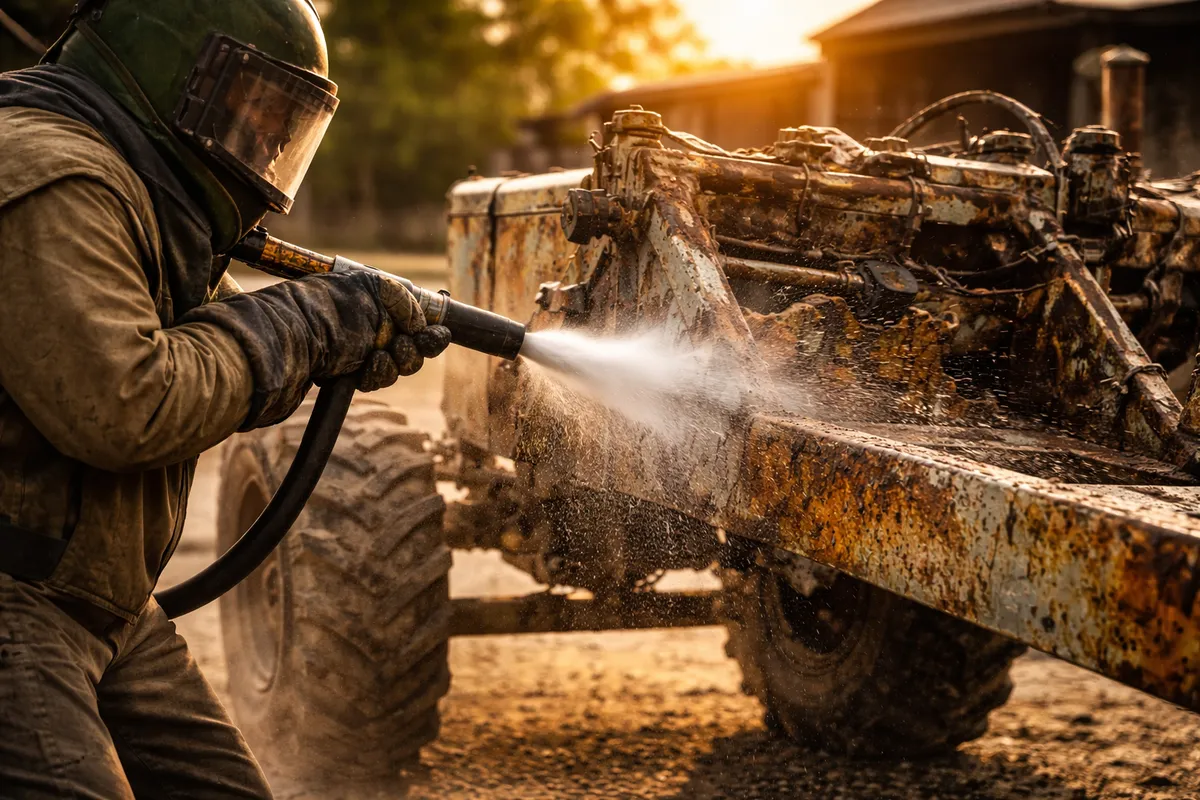
Black Beauty coal slag has been the default blasting media for heavy equipment for decades. It's cheap, it's everywhere, and it cuts fast. We used it for years on excavators, dozers, loaders, and fleet trucks. Then we switched to crushed glass and garnet — and we're not going back.
Here's why.

What Black Beauty Actually Is
Black Beauty is a brand name for coal slag abrasive — a byproduct of coal-fired power plants. When coal burns, theite mineral content melts and forms glassy granules. These get collected, screened to size, and sold as blasting media.
It works. Nobody's arguing that. The issue is what comes with it.
The Silica Problem
Black Beauty is marketed as "low free silica" — typically less than 1% crystalline silica content. That sounds safe until you understand the math. OSHA's permissible exposure limit (PEL) for respirable crystalline silica is 50 micrograms per cubic meter over an 8-hour shift. That's an incredibly small amount.

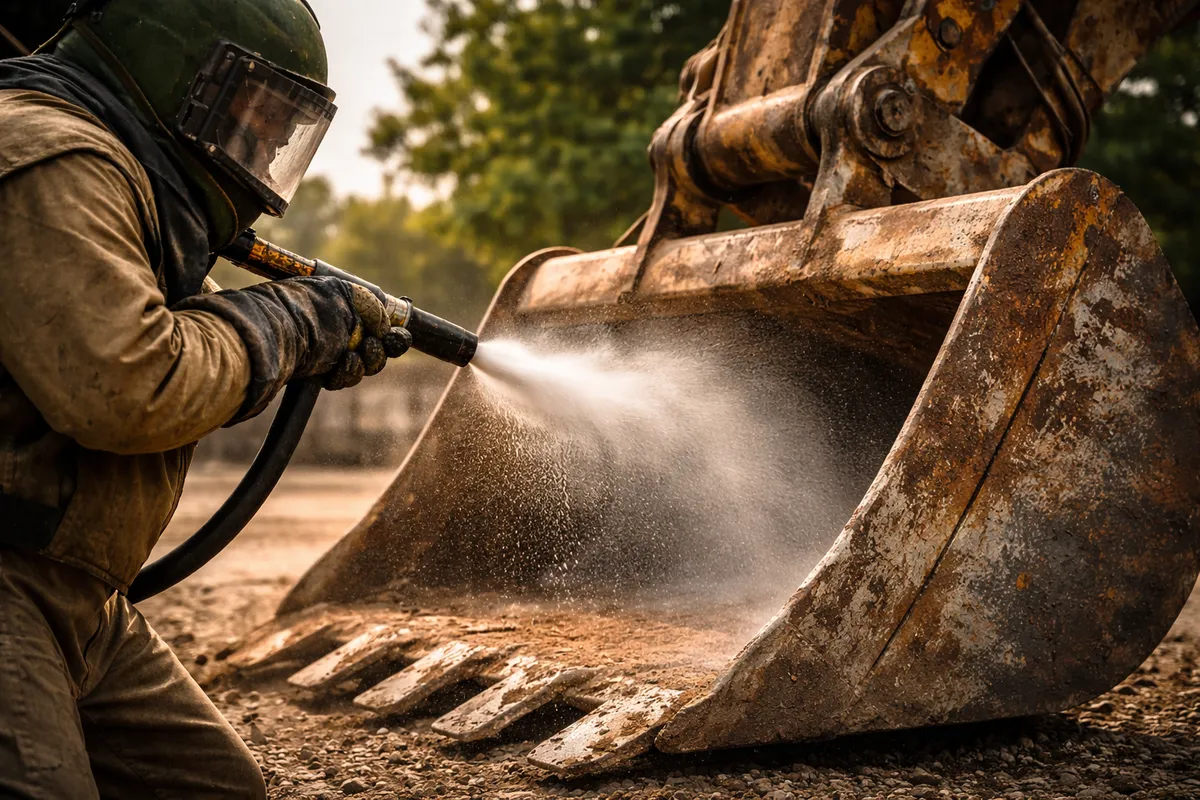
When you're blasting a CAT 330 excavator for 6 hours straight, even "low silica" media generates enough respirable dust to exceed that limit without proper engineering controls. The dust is fine, it hangs in the air, and it gets into your lungs.
Silicosis is real. It's irreversible. It's caused by inhaling crystalline silica dust over time, and it kills blasters who don't take exposure seriously. OSHA has been tightening silica regulations since 2016, and enforcement is only getting stricter.
The Dust Problem
Coal slag is a single-use media — it fractures on impact and turns to dust. On a big equipment job, you're generating massive volumes of spent media and airborne particulate. That means:
- More containment required
- More respirator filter changes
- More cleanup time
- More disposal cost (coal slag dust with lead paint residue is hazardous waste)
The "cheap" media stops being cheap when you factor in the full cost of using it.

What We Use Now
Crushed Recycled Glass
Our primary media for heavy equipment exteriors. It's made from 100% recycled bottle glass — zero free silica, angular profile, and it cuts just as aggressively as coal slag at comparable mesh sizes. It generates significantly less dust because the particles are harder and don't fracture as readily.
- Mesh size: 30/70 for heavy rust and mill scale, 40/70 for general coating removal
- Profile: 2.0-4.0 mils depending on pressure and standoff distance
- Reusability: Single use, but cheaper to dispose of (non-hazardous)
Garnet (GMA 80 Mesh)
For jobs that require a precise, consistent surface profile — like when the equipment is getting an industrial epoxy system that specs a specific anchor pattern. Garnet is a naturally occurring mineral, extremely hard (7.5-8.0 on the Mohs scale), and produces a very uniform profile.
- Mesh size: 80 mesh is the industry standard for structural steel
- Profile: Extremely consistent 2.5-3.5 mil range
- Reusability: Can be recycled 3-5 times before it loses its cutting edge
- Cost: More expensive per bag, but the reusability makes it competitive
Steel Grit
For tank interiors and surfaces that need an aggressive profile for thick-film coatings. Steel grit is the hardest-hitting media we run. It's not for everything, but when you need a 4-5 mil profile on heavy plate steel, nothing else comes close.
Real-World Comparison
On a recent fleet job — 8 dump trucks, full exterior strip and reprime — we tracked the numbers:
| Factor | Coal Slag | Crushed Glass | |--------|-----------|---------------| | Media cost per truck | ~$180 | ~$220 | | Cleanup time | 3+ hours | 1.5 hours | | Disposal | Hazardous (lead paint contaminated) | Standard waste | | Dust exposure | High — constant filter changes | Moderate — less airborne particulate | | Surface profile | Inconsistent 2-4 mil | Consistent 2.5-3.5 mil |
The glass costs slightly more per bag but saves hours in cleanup and disposal headaches. On an 8-truck job, we came out ahead by about $1,200 total.
Protecting What You're Not Blasting
Heavy equipment has hydraulic cylinders, bearings, seals, electrical connectors, and glass that all need to be masked or shielded before blasting. We use a combination of:
- Magnetic shielding blankets for flat steel surfaces adjacent to the blast zone
- Silicone plugs and caps for hydraulic ports
- Plastic sheeting and tape for glass and cab interiors
- Custom plywood shields for cylinder rods
Skipping the masking step is how you turn a $3,000 blast job into a $15,000 hydraulic repair.

The Bottom Line
Black Beauty works. We're not pretending it doesn't. But the dust, the silica exposure risk, the disposal costs, and the inconsistent profiles make it a worse choice than what's available now. Crushed glass gives you the same cut with less risk, less mess, and a better finished product.
If you've got heavy equipment that needs stripping, we'll come look at it and give you a quote based on the actual scope — not a per-hour guess.