Stripping Anti-Fouling Paint from Fiberglass Hulls Without Wrecking the Gelcoat
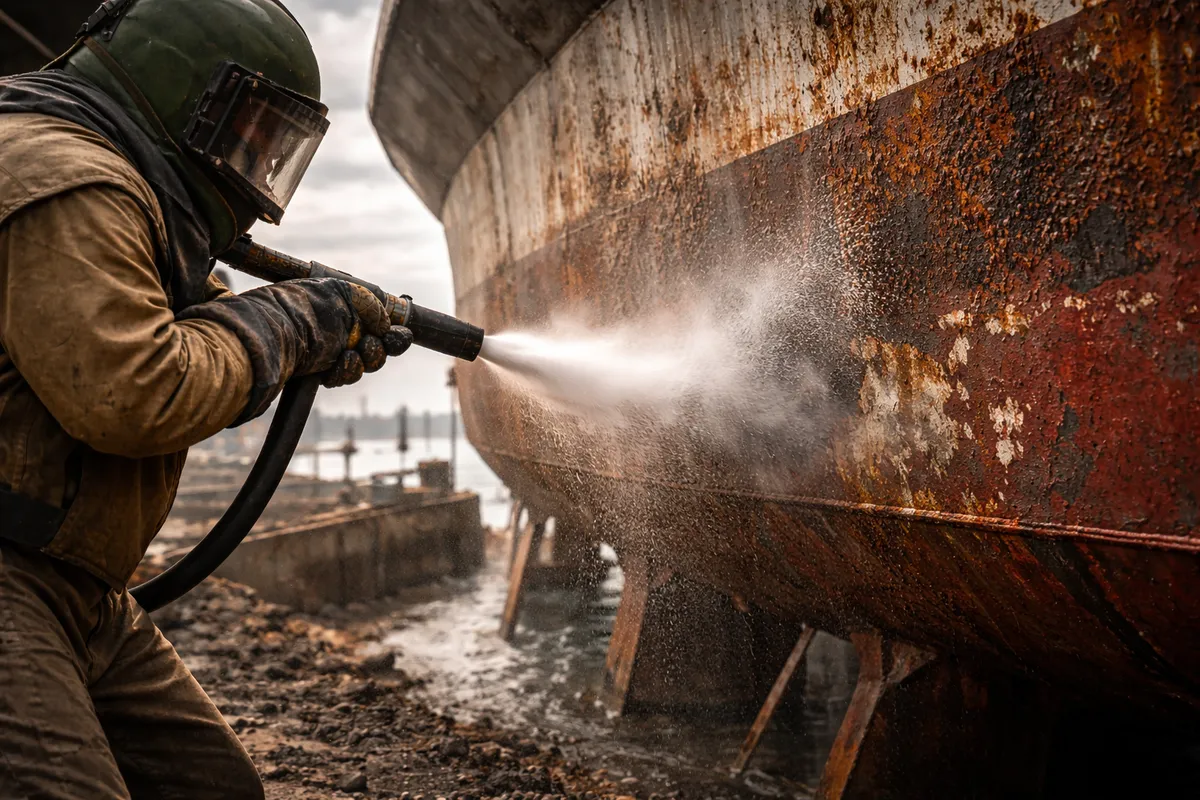
Removing bottom paint from a fiberglass boat is one of the trickiest blasting jobs there is. The anti-fouling coatings are designed to be tough — they have to survive years of saltwater immersion. But the gelcoat underneath is relatively fragile. Blast too hard and you'll chew right through it. Go too soft and you'll be out there for days making no progress.
Here's how we handle marine hull work.

Why Bottom Paint Removal Is Different
Anti-fouling paints contain biocides (historically copper-based compounds) that prevent barnacles, algae, and other marine organisms from attaching to the hull. These paints are formulated to be extremely adhesive and abrasion-resistant. Most boats accumulate 5-15 layers over their lifetime, and each layer bonds to the one below it.
The challenge is that fiberglass gelcoat — the smooth, colored outer layer of the hull — is only about 15-25 mils thick. That's roughly the thickness of a few sheets of paper. Damage the gelcoat and you're looking at expensive repairs and potential osmotic blistering down the road as water penetrates the laminate.
Media Options for Fiberglass
Crushed Glass (Fine Mesh)
Our go-to for most marine hull work. We use a fine 40/70 or finer mesh crushed glass at low pressure (30-50 PSI) with a wide fan nozzle. The fine particles remove paint effectively while the low pressure prevents gelcoat damage. The key is keeping the nozzle at a consistent 18-24 inch standoff distance and never dwelling in one spot.
Walnut Shell
For boats with thin or already-damaged gelcoat, walnut shell is the safest option. It's softer than glass (about 3.0-3.5 on the Mohs scale vs 5.5 for glass) and won't cut into the gelcoat even at moderate pressures. The tradeoff is speed — walnut shell takes roughly twice as long as crushed glass for the same area.
Dustless / Wet Blasting
Mixing water with the abrasive stream suppresses dust (important when dealing with copper-laden anti-fouling paint) and cushions the impact on the gelcoat. This is becoming the preferred method for boatyards that do high-volume bottom paint removal. The water also helps flush away spent media and paint residue.
What About Soda Blasting?
Soda blasting (using sodium bicarbonate as the media) was popular for marine work in the 2000s because it's extremely gentle on gelcoat. The baking soda particles are soft enough that they won't damage the surface even at higher pressures.

The downsides: it's slow, it's expensive per square foot, the media can't be reused, and the alkaline residue needs to be thoroughly neutralized and rinsed before any new coatings will adhere properly. If you don't get all the soda residue off, your new barrier coat and bottom paint won't stick.
Most professional marine blasters have moved toward fine crushed glass or dustless blasting systems for production work. Soda still has its place on delicate or high-value vessels where speed isn't the priority.
The Process
-
Haul and block. The boat needs to be out of the water and properly supported. We work with local boatyards for haul-out coordination.
-
Masking. Waterline stripe, boot stripe, hull graphics, through-hulls, transducers, and any hardware that isn't being stripped gets masked with heavy plastic and tape.
-
Test patch. Before blasting the full hull, we do a 12x12 inch test area to dial in the pressure, media flow, and standoff distance for that specific hull's gelcoat thickness and paint buildup.
-
Blast. Working in systematic passes from the waterline down to the keel. Consistent speed, consistent distance, consistent overlap.
-
Inspection. After stripping, we inspect the gelcoat for any damage, crazing, or osmotic blisters. This is the time to address any gelcoat repairs before new coatings go on.
-
Rinse and prep. Thorough freshwater rinse to remove all media residue and paint dust. The hull needs to be clean and dry before barrier coat application.
Barrier Coat and Bottom Paint
Once the hull is stripped to clean gelcoat, most boats get a two-part epoxy barrier coat (like Interlux Interprotect or TotalBoat TotalProtect) applied in 2-3 coats. This seals the gelcoat and prevents water intrusion. After the barrier coat cures, new anti-fouling bottom paint goes on.
The barrier coat needs to go on within 24-48 hours of blasting to prevent moisture absorption into the exposed gelcoat. We coordinate timing with the boat owner's paint schedule to make sure there's no gap.

What We See Go Wrong
- Too much pressure. Guys running 80+ PSI with aggressive media on fiberglass. The gelcoat gets chewed up and now you need $2,000+ in gelcoat repair before you can even paint.
- No test patch. Every hull is different. Different gelcoat thickness, different paint systems, different number of layers. You have to test before committing.
- Skipping the barrier coat. Stripping to bare gelcoat and slapping bottom paint directly on it. The paint won't last and you're inviting osmotic blistering.
- Not managing the dust. Anti-fouling paint dust contains copper and other biocides. It's not something you want blowing around the boatyard. Proper containment and dust suppression aren't optional.
Get a Quote
If your boat needs bottom paint removed, reach out with the hull length, approximate number of paint layers, and whether you need barrier coat application coordinated. We'll give you a straight number.